Skip to content

WHO WE ARE

At Ooredoo, we believe in the power of connection to drive human progress and create a digital future for all

Overview

Sustainability Framework

ESG Framework

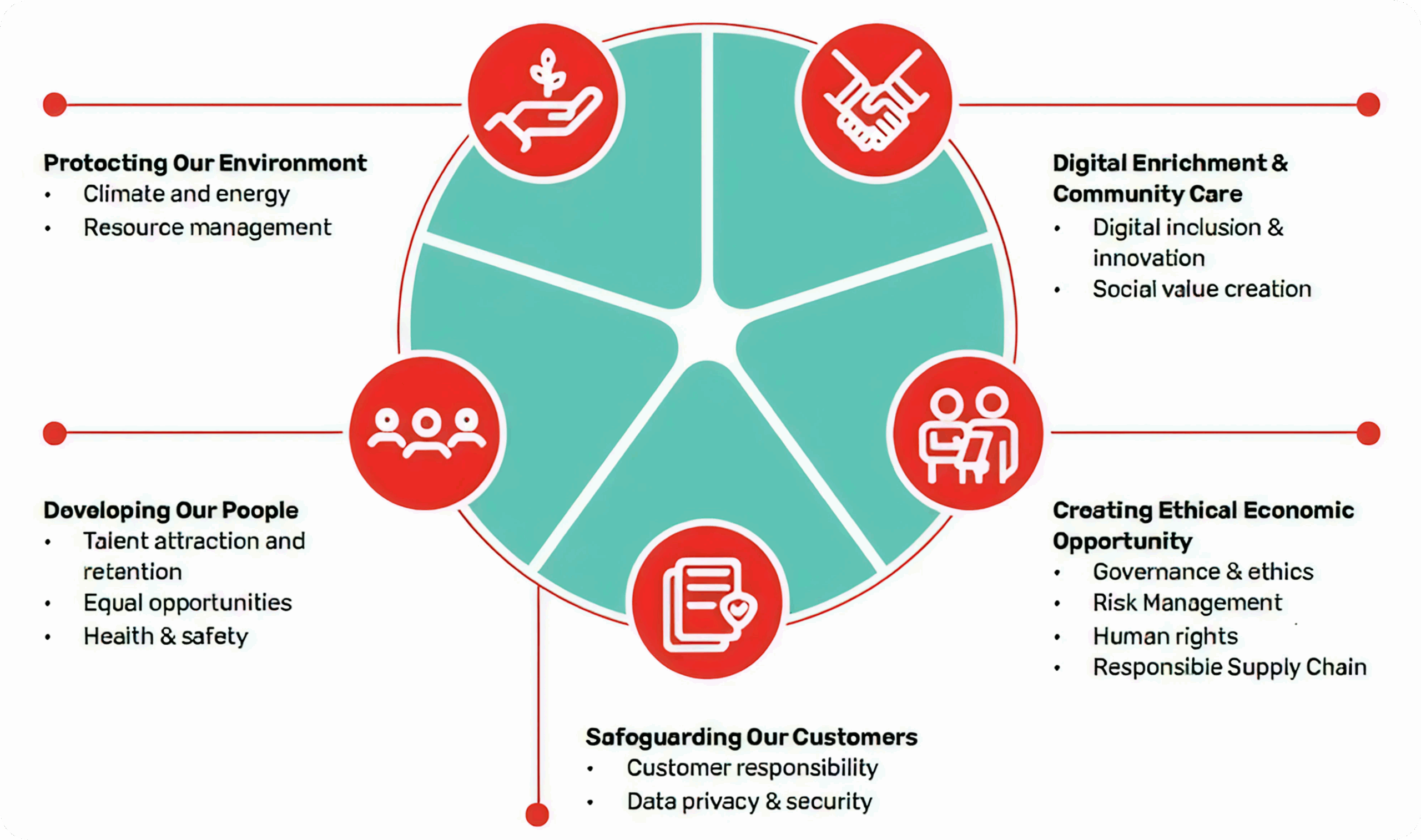
Introduced in 2023, our ESG framework provides the foundation for integrating sustainability into our business operations. Built around five strategic pillars, the
framework enables us to align sustainability objectives with commercial priorities and stakeholder expectations.

It informs how we design our policies, develop partnerships, and measure our progress—ensuring that environmental, social, and economic outcomes are considered across all levels of decision-making. As we move forward, we continue to evolve our practices and find new opportunities to generate shared value.


Across all the pillars of our framework, we emphasize the empowerment of women and youth entrepreneurship, particularly in underserved communities.


ESG Governance

In 2024, Ooredoo Group (OG) established a dedicated Group-wide Sustainability function under the leadership of the Group Chief Human Resources and Sustainability Officer. Oversight of our ESG strategy and performance is provided by a Board-level Sustainability Committee, ensuring alignment with our business strategy, risk management, and stakeholder engagement practices.

As part of our broader governance enhancements, the Nomination and Remuneration Committee was restructured into the Remuneration, Nomination and Sustainability Committee, formally embedding ESG accountability at the Board level. This reflects our long-term commitment to integrating sustainability across the highest levels of leadership and decision-making.

At the operational level, our OpCos have taken concrete steps to localize and integrate ESG governance. ESG working groups are now active in all markets, with initiatives including the designation of Single Points of Contact (SPOCs) for ESG, structured data collection processes, and integration of ESG indicators into executive performance frameworks.

These efforts are exemplified by Asiacell establishing a core ESG working group and charter to drive sustainability maturity, integrating materiality assessment outcomes into its operational practices. Ooredoo Kuwait, which has designated ESG SPOCs within each department, with sustainability metrics being incorporated into executive KPIs and supported through regular training. Ooredoo Oman has tied ESG targets to employee incentives and financial rewards, while maintaining board-level oversight and ensuring transparent reporting. Ooredoo Tunisia has established a cross-functional ESG team that facilitates variance analysis, coordinates data collection, and supports ESG integration across departments. Meanwhile, Ooredoo Qatar conducted a double materiality assessment and is embedding ESG into its core business strategy through a dedicated internal sustainability function.


Materiality Assessment

In 2023, we conducted a materiality assessment in accordance with the GRI Universal Standards 2021 and the double materiality principles, identifying and prioritizing key issues of significance for both our business and stakeholders.

Aligned with the latest sector-specific GRI standards, we integrated impact analysis to not only rank material topics by their importance but also to focus on the most pressing concerns for our stakeholders, including communities, environmental groups, and social organizations. As part of our materiality process, we incorporated stakeholders’ opinions through a survey to understand both the positive and negative impacts based on their perspectives and needs.

Transparency and open communication remain at the core of our approach.


Ongoing Stakeholder Engagement

Our Stakeholder Engagement Plan goes beyond periodic materiality assessments, by maintaining ongoing dialogue with those impacted by our operations. This allows us to proactively address environmental and social impacts through clear mitigation strategies.